
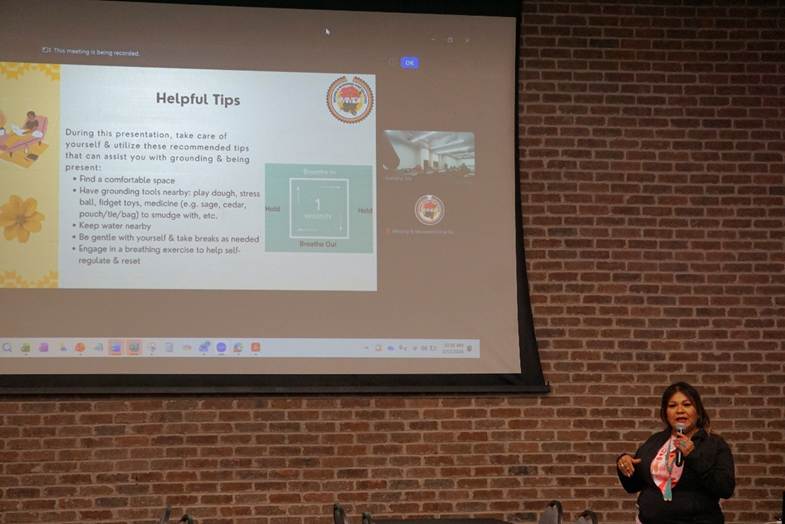
Vangie Randall Shorty welcomed participants to the Murdered Indigenous Peoples Forum.
GALLUP – A meaningful and educational forum on murdered relatives was held Friday at the El Morro Events Center in Gallup, N.M., hosted by the Missing and Murdered Diné Relatives Coalition (MMDRC).
During the Murdered Indigenous Peoples Fourm, family members of murder victims shared their stories and information they learned as they navigated the justice systems.
MMDRC Project Manager Zunnebah Jim said that the Coalition wants to develop a toolkit for families of murdered victims, similar to the toolkit that it developed for families of missing persons.
“We need everyone in all our communities to help,” she said.
MMDRC is also planning to hold healing circles like the one held Friday in different communities in the coming months.
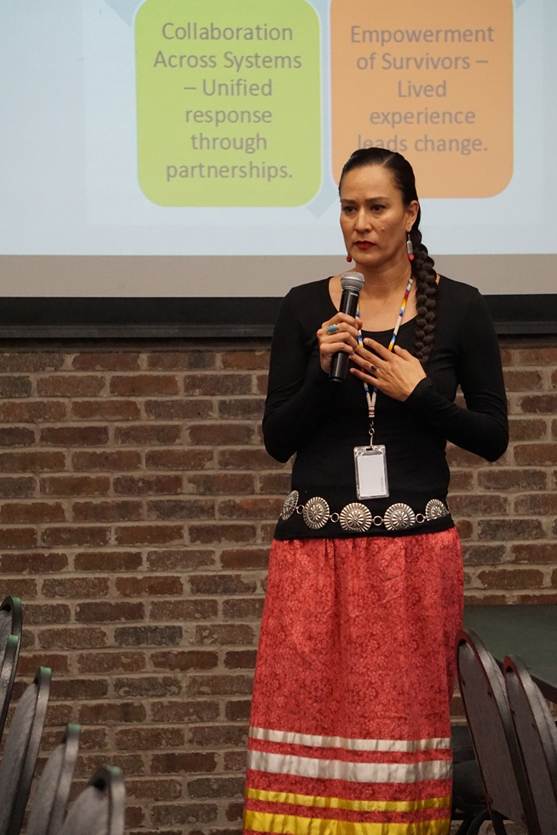
Sierra Yazzie Asamoa-Tutu, Gallup City Councilor, expressed support for the work being done.
Local resources such as Department of Family Services, Division of Behavioral and Mental Health Services, and Battered Families Services were invited to describe their programs and how to access services with them.
Though resources were on hand at the forum, a key takeaway was that there are very few resources aimed specifically at the family members of murder victims. Sonlatsa Jim recently experienced the court hearing for her dad Sonny Jim, who was murdered in 2009 in Grants, N.M. One of her main supporters during the hearing was Vangie Randall Shorty, whose son, Zachariah Juwaun Shorty, was murdered in 2020. Only recently three people were charged in his case. Shorty told the forum members that she had to advocate tirelessly for her son.
“Sharing our loved ones’ story and saying their name is very important,” she said.
The same message was given by Jim, who said she had to constantly be advocating to get justice for her dad.
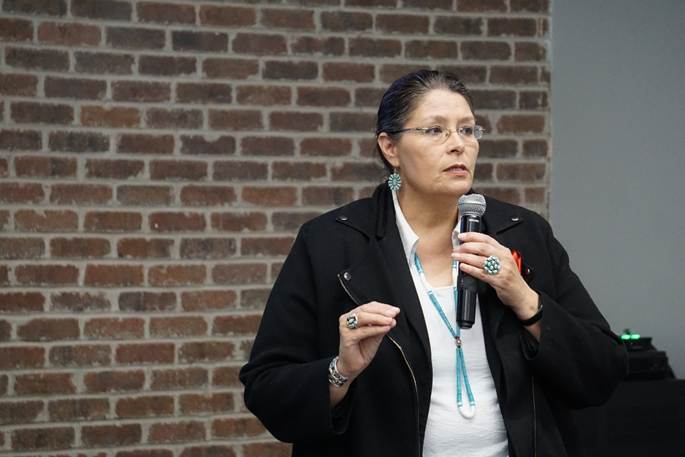
Sonlatsa Jim, NDCFS Deputy Director, presented on the Diné Action Plan.
One of the presentations during the forum was on the Diné Action Plan (DAP) Violence Task Force. The DAP is a roadmap for the Navajo Nation to address four monsters of Navajo society, including suicide, substance abuse, violence, and missing and murdered Diné relatives. Jim leads the Violence Task Force, but the four monsters intersect with each other where collaboration between Navajo Nation entities and partners is important to provide capacity building and public education.
Jim said that the task force addresses all types of violence and is focusing on services for the Navajo people on and off the Navajo Nation, culture as prevention, prevalance and incidence rates, and working with Navajo Nation Public Safety to reduce violence. One of the current projects for the task force is to develop a victim advocacy resource booklet.
“We need each other as partners. When something violent happens to one of our relatives, we know we need to have a unified response system so that is one of the key areas we are moving to address,” Jim said. She also emphasized lived experience from survivors and invited participation in the task force meetings.
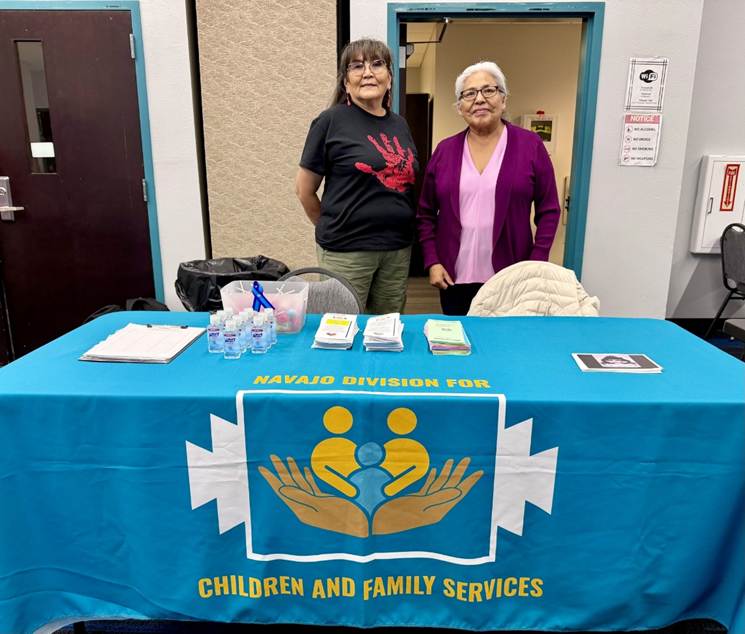
Althea James and Geraldine Brown of Department of Family Services provided public education on victim witness advocacy.
The Navajo Division for Children and Family Services is leading the implementation of the DAP. The DAP is currently being reviewed by the DAP Advisory Group, Chair, Co-Chair and task forces. The review will provide recommendations for updates to the plan.
The forum ended with a presentation on coping strategies after a homicide or traumatic event that family members can utilize. “If you don’t know what families need, ask them,” said Jim.