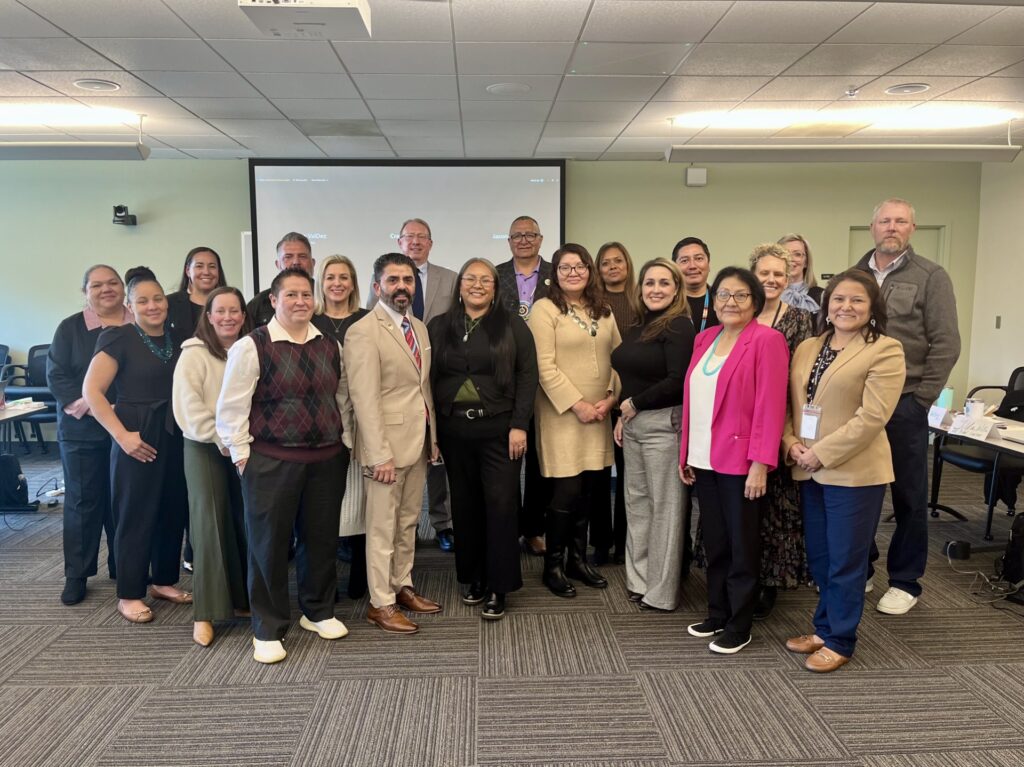
The Navajo Division for Children and Family Services (NDCFS) held the annual Tri-State Meeting with Utah, New Mexico and Arizona for all entities to report on important updates on services and policies related to enforcing the federal Indian Child Welfare Act (ICWA).
The ICWA was enacted in 1978 to set minimum standards for state child custody cases involving Native American children. The law was in response to historical high rates of forced removal of Native American children from their families and communities. It requires efforts to keep families intact, prioritizes placement within a child’s family and community, and mandates that the child’s tribe and family are informed of state court proceedings.
The annual meeting allows the Navajo Nation and the three states to come together and share information and ideas. This year, the state of Utah hosted the meeting at the Matheson Courthouse.
From the Navajo Nation, NDCFS Executive Director Thomas Cody, Department of Family Services (DFS) Department Manager Crescentia Tso, and Navajo Indian Child Welfare Act Program (NICWAP) Principal Social Worker Lashaina Hoskie provided reports.
Cody expressed appreciation for the partners from the three states for attending the meeting. He reminded all attendees that they have a shared responsibility to oversee the cases involving Navajo children because those children will become adults who have the potential to contribute to society. The attendees also share the voices of the children they work with. Cody said that their culture is very important. “I would like our children to be connected to their language and culture. I’m glad you all respect that,” he said.
The NDCFS rebranded from the Division of Social Services to the Navajo Division for Children and Family Services in 2024, Cody reported. He also informed the partners that the NICWAP has a new manager, Jason Curley.
Tso provided information on the DFS including the Healthy Families Program, Adult Care Services, and Protective Services. The Healthy Families Program is the preventative part of the DFS. Adult Care Services is for in-home or group home care for vulnerable adults. Protective Services responds to abuse and neglect reports with a priority for child and family well-being.
Tso reported that DFS field offices received 2,727 intakes from January to October 2025. The DFS serves 263 children through its field offices.
Tso informed the states that the NDCFS has entered into a P.L. 102-477 contract for its federal programs and the first report will be due in December. “This was an opportunity for us to expand services,” she said. She gave an example of a need to assist families when they lack resources to attend court hearings.
Tso updated the states that the NDCFS and partners are working on proposing amendments to the Navajo Nation Áłchíní Bi Beehaz’áanii Act and Vulnerable Adult Protection Act.
Hoskie provided the update on NICWAP. The NICWAP provides case management services and consults, collaborates and coordinates with state child welfare agencies and courts with a goal of preventing arbitrary removal of Indian children from their families and tribes. NICWAP has 456 cases involving 857 children in 30 states. Nearly 70% of the children that the NICWAP serves are in ICWA preferred placement, which prioritizes keeping Indian children within their families and tribes.
Hoskie said that the program is hiring a staff member to work out of Mesa, Ariz., which is important because the highest number of cases by state is in Arizona. She said that NICWAP also has cases where no state agency is involved but that the program holds private petitioners to standards of ICWA.
The Navajo Nation received updates from the Utah Office of Indian Health and Family Services, Utah Administrative Office of the Courts (AOC), Arizona Department of Family Services, and New Mexico Children, Youth and Families Department.
###