
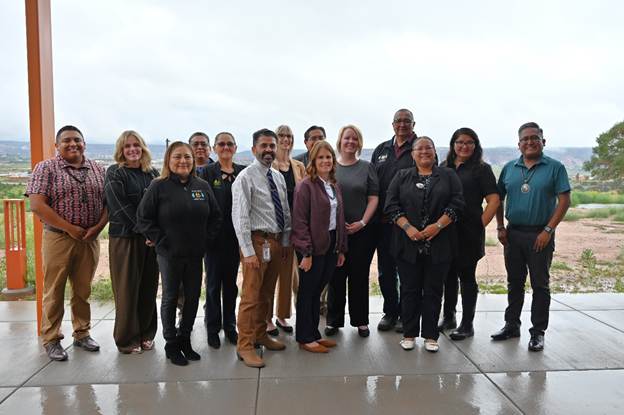
ST. MICHAELS, Ariz. – The Navajo Nation hosted officials from the Utah Department of Health and Human Services (DHHS) for their quarterly meeting on September 17, 2026.
As part of their Indian Child Welfare Act (ICWA) Intergovernmental Agreement (IGA), the Nation and the state both mutually agree to meet each quarter. The meeting allows the Navajo Division for Children and Family Services (NDCFS) and the DHHS to update each other with important information on their respective operations.
The NDCFS and the state continue work on updating their ICWA Intergovernmental Agreement, which was executed in 2019. Jason Curley, Navajo ICWA Program Manager, said that the proposed amendments are near finalization.
The ICWA is a federal law enacted in 1978 in response to forced removal of Native American children from their homes. The law sets minimum standards for removal and placement of Native American children and provides guidance to states regarding such cases. It recognizes the federal responsibility to tribes to preserve their culture, heritage, language and identity.
The ICWA authorizes tribes and states to enter into agreements to further the purposes of the law.
With the current IGA, the Nation and the state agree to establish a government-to-government relationship in ICWA matters, protect and further the best interests of the Navajo child and his or her family, prevent cultural separation of Navajo children from their families and communities, and, when possible, have the child be raised with his or her family and the Navajo culture.
NDCFS Executive Director Thomas Cody welcomed the DHHS representatives to the Navajo Nation.
He expressed his appreciation for the continued work being done to ensure the well being and safety of Navajo children, including the review of the IGA to reaffirm both the Nation’s and the state’s commitment to uphold the ICWA and to provide clarification on their roles and responsibilities.
Dr. Jordon Begay of the Department for Child Well Being (DCWB) updated the state on changes to the Department’s plan of operation that transition the Navajo ICWA Program into the DCWB. He said the transition does not change the need for timely notification and regular consultation on custody cases involving Navajo children and the state should continue sharing information on such cases as early as possible.
Curley said the partnership with the state of Utah is vital to the success of the Navajo ICWA Program and the services it provides to Navajo families and children, especially since Utah has one of the highest numbers of Navajo ICWA cases among all states. He said that the Navajo Nation is engaged in conversations on the development of an ICWA court with Salt Lake City County and both the Nation and the state are improving and strengthening the referral process.
“We have a strong and positive relationship with our state partners from Utah. Their continued willingness to engage with Navajo creates opportunities for us to enhance our services and responses to Navajo child welfare issues within the state,” he said.
“We are grateful that Utah continues to come to the table to discuss very important issues impacting our Navajo children and families,” Curley said.
The Navajo ICWA Program was established to promote the stability and security of Navajo families by providing services to preserve and reunite Navajo families who are located off the Navajo Nation with children who are subject to removal for placement in foster care or adoptive homes. The program supports the permanent placement of Native American children in Native American homes for the preservation of cultural identity.
###