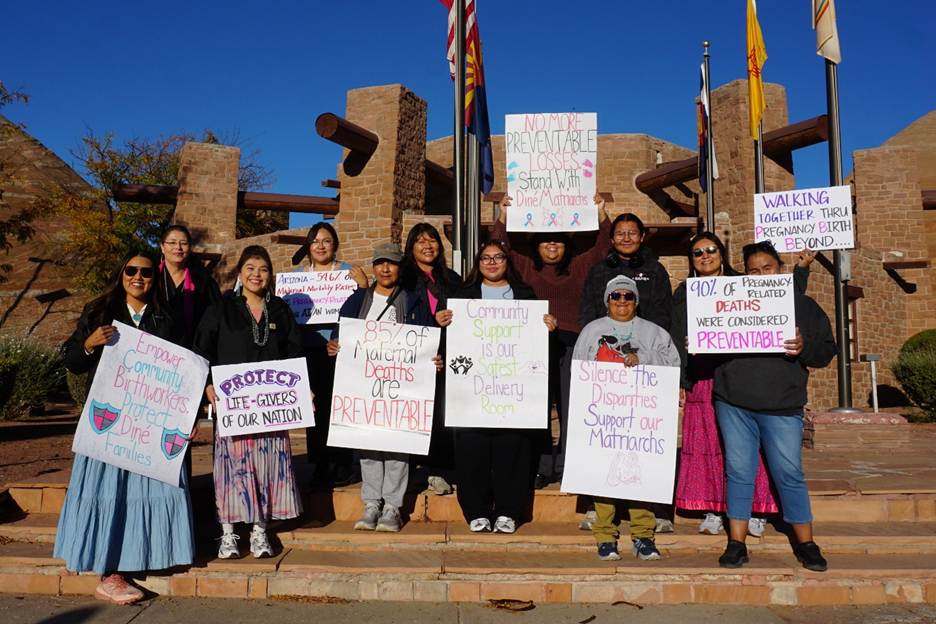
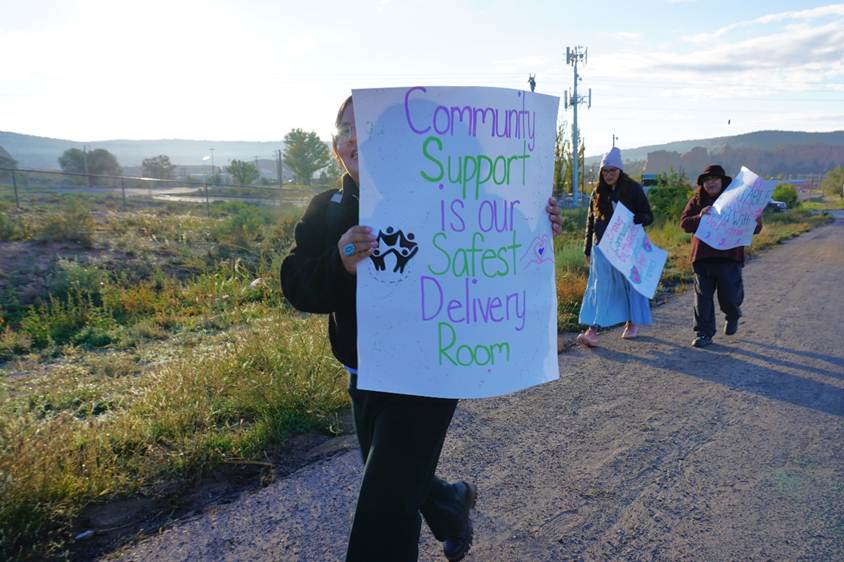
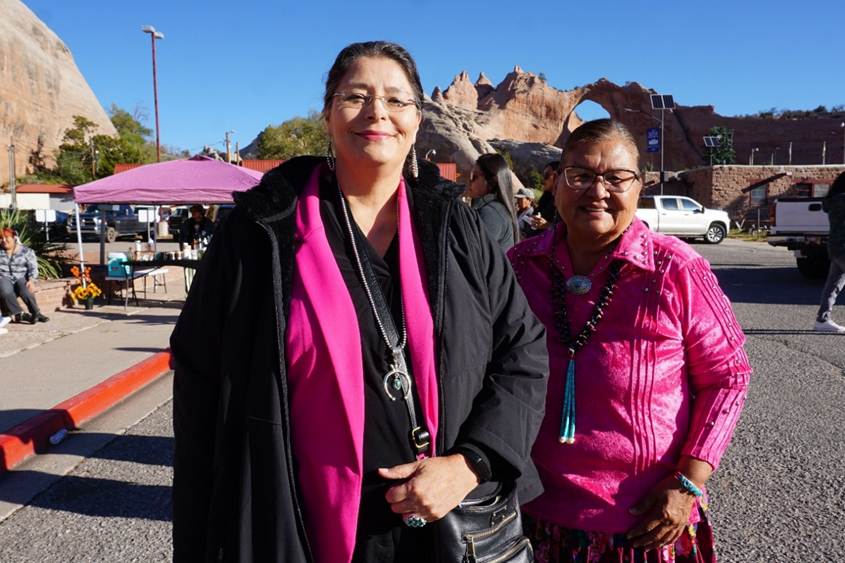
WINDOW ROCK – The Navajo Division for Children and Family Services participated in the Maternal Mortality Awareness Walk hosted by the Navajo Birthworker Collective Tuesday morning.
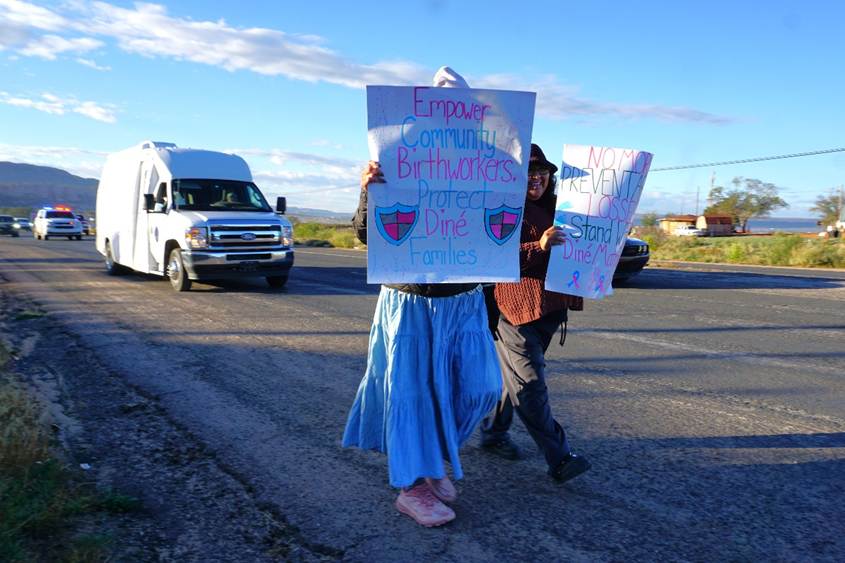
Wearing pink and blue, participants walked from the Lowe’s parking lot to the Navajo Nation Council Chamber where presenters spoke on the issue of maternal mortality. NDCFS Deputy Director Sonlatsa Jim gave the invocation and benediction and also offered remarks on the Diné Action Plan.
Maternal mortality is becoming an urgent issue. Walkers carried signs stating that 85% of maternal deaths are preventable, 54.6% of maternal mortality rates are pregnancy-related among American Indians and Alaska Natives (AI/AN) in Arizona, and that the northern region of Arizona has the highest rate of pregnancy-associated maternal deaths.
Diné College’s Healthy Navajo K’é Project also shared data through handouts at the event, which stated that in the United States, the maternal mortality rate was 23.8 deaths per 100,000 live births. However, for AI/AN women, the pregnancy-related mortality ratio (PRMR) was 54.6 pregnancy related deaths for every 100,000 live births. In Arizona, the PRMR among AI/AN women is 60.1 per 100,000 live births. In New Mexico, the PRMR among AI/AN women is 52.9 per 100,000 live births.
According to the Healthy Navajo K’e Project, factors that contribute to the high mortality rates include limited access to care, bias in healthcare, socioeconomic barriers, higher rates of chronic conditions, mental health and substance use disorders, and deficiencies in health education.
Prevention methods begin before pregnancy and continue after birth, including family planning, beginning prenatal care early, seeing a health care provider during pregnancy, and attending postpartum visits.
Amanda Singer, Executive Director of the Navajo Birthworker Collective, said that there is a maternal health void that needs to be addressed.
“Every day that this is there, without bringing more awareness to it, it’s just going to get worse. In Arizona, the data is showing it is getting worse,” Singer said. She noted that maternal health care resources are scarce or inaccessible for many people on the Navajo Nation.
Amber Rose Begay, project coordinator for the Healthy Navajo K’e Project, said that on the Navajo Nation, first trimester prenatal care rates are below national averages.
“Navajo women face challenges in getting prenatal care including transportation barriers, long travel distances to healthcare facilities and limited access to facilities and providers,” Begay said. Nutrition is another challenge for maternal health due to limited access to healthy food, she said.
“By supporting maternal health, we can improve outcomes for mothers, babies, and their families,” Begay said.
Deputy Director Jim said this is an important topic that does not get talked about enough.
“We want to make sure that the message gets out there for our Navajo families and our Navajo leadership,” Jim said. She advocated for fathers and children to also understand maternal health because it impacts the whole family.
The Centers for Disease Control defines maternal death as “the death of a woman while pregnant or within 42 days of termination of pregnancy, irrespective of the duration and the site of the pregnancy from any cause related to or aggravated by the pregnancy or its management, but not from accidental or incidental causes.” Maternal mortality rate is the number of maternal deaths per 100,000 live births.
The Navajo Nation Women, Infants and Children Program under the Navajo Department of Health also took part in the event.
###